
McIntosh Deed Records by Type
The GSCCCA index uses more than one deed label. Match the instrument to the event, then open the deed image itself. A deed records a conveyance filed with the clerk, and the label alone settles no right or defect in McIntosh County property records.
| Deed Type | What It Does | Common Use |
|---|---|---|
| Warranty deed | Conveys land with stated title promises | Ordinary sale |
| Quit claim deed | Transfers the grantor's stated interest without broad warranties | Family transfer or claim cleanup |
| Deed from estate | Conveys through an estate fiduciary | Estate administration |
| Trustee's deed | Conveys through a trustee | Trust transaction |
| Tax sale or sheriff's deed | Records a transfer following a stated legal process | Forced or tax-related conveyance |
A security deed or lien burdens an interest rather than conveying it. It is not an ownership deed. Search later McIntosh County releases and cancellations instead of assuming a newer deed ended the old claim in the deed records.
McIntosh County Grantor-Grantee Chain
The GSCCCA Real Estate Name Search lets you set Party Type, Instrument Type, County, a neighboring-county option, name, date, result-count, and display controls. Type individuals last name first. Select MCINTOSH and test both party roles to cast a wide net across McIntosh County deed records.
- Find the tax-roll owner and parcel identity.
- Search that owner as grantee and open the newest deed matching the land.
- Record the grantor, dates, book and page or instrument number, and legal description.
- Search that grantor as a grantee in the prior period, then use deed books when the online index ends.
- Grantor
- The party conveying an interest.
- Grantee
- The party receiving an interest.
- Chain of title
- The linked sequence of transfers affecting one tract.
- Book/page or instrument number
- The clerk reference used to retrieve a filed document.
Filter McIntosh Deed Records
Party Type narrows to All Parties, Grantor, or Grantee. The instrument list spans warranty and quit claim deeds, estate, trustee, sheriff, tax sale, and foreclosure deeds, plus security deeds, releases, easements, covenants, court orders, and other interests. Use those filters. From and Through dates also tame a common surname in a McIntosh County property search.
| Search control | Setting | Use |
|---|---|---|
| County | MCINTOSH | Keep the chain local |
| Party role | Grantor or Grantee | Separate giver from receiver |
| Name | Last, first or entity | Test initials and punctuation |
| Date | Optional range | Split a long history |
The captured deed-index form shows these controls.
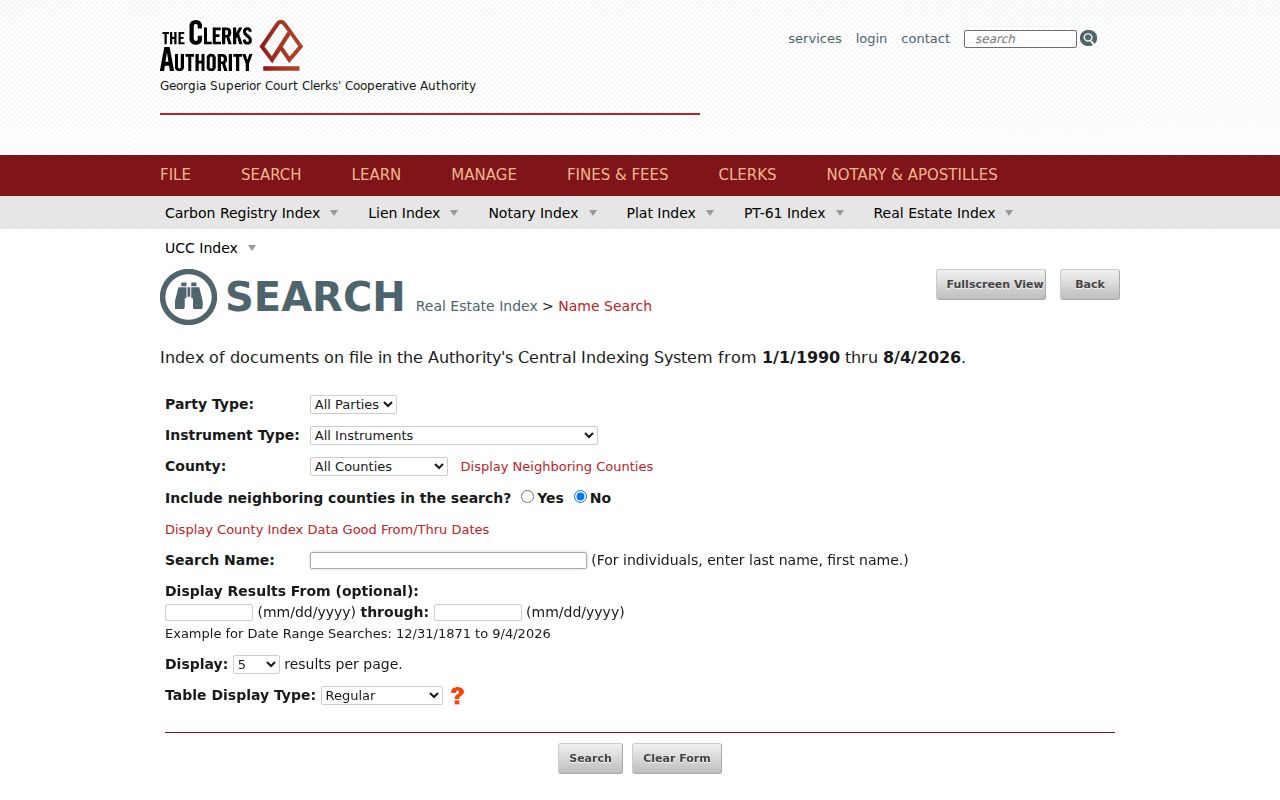
Its role and instrument filters are the core of a McIntosh deed search.
McIntosh Deeds Before 1971
The county-specific GSCCCA table showed McIntosh indexing from January 1, 1971 through September 1, 2026 when inspected. That is an online threshold, not the start of land records. FamilySearch catalogs McIntosh deed books beginning in 1863.
The Georgia Archives county cards, clerk vault, FamilySearch, and Lower Altamaha Historical Society are older-record routes. Courthouse-loss sources disagree on dates, listing 1863 or 1864, 1872 or 1873, 1931, and 1981 or 1986. Check more than one repository near those periods.
The official coverage image comes from the GSCCCA county-date screen.
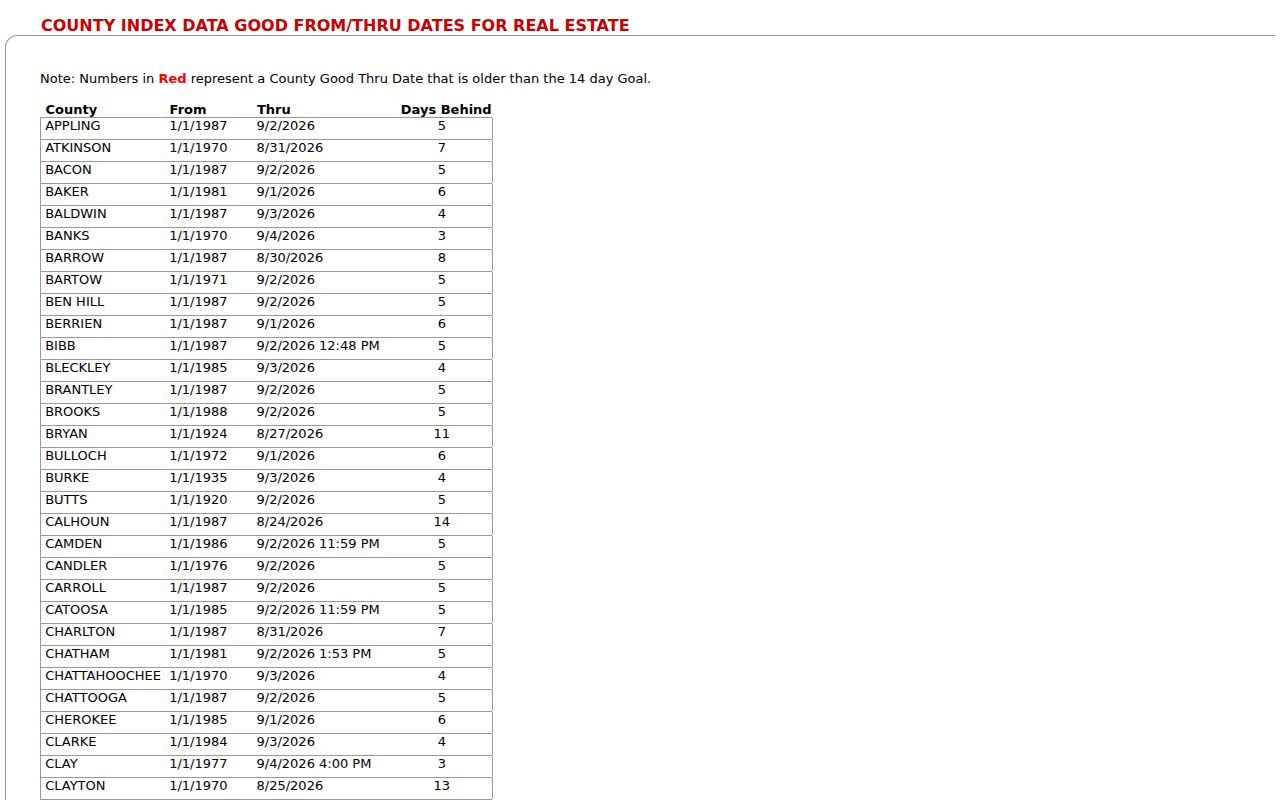
Read 1971 as web access depth and use deed books for the earlier chain.
Interests Filed Beside McIntosh Deeds
Beyond simple transfers, search SECURITY DEED, RELEASE, CANCELLATION, ASSIGNMENT, EASEMENT, RIGHT OF WAY DEED, RESTRICTIVE COVENANTS, BOUNDARY LINE AGREEMENT, LIEN, COURT ORDER, and ESTATE DOCUMENTATION. The separate lien index covers McIntosh from April 22, 2003. A release should point back to the prior filing. Read them together. A paid tax bill does not release a mortgage. An assessor card does not reveal every recorded burden.
McIntosh Filing Alerts Look Forward
The Filing Activity Notification System sends alerts. Each one fires when a new filing is indexed under a chosen name. It watches forward, not backward. Alerts rely on clerk-transmitted indexing and are not guaranteed complete or current. Enroll after reviewing the McIntosh County deed chain. A missed alert does not prove the absence of a recording.
Book and Page Confirm McIntosh Land
A name hit alone proves little. Tie every match to the right tract. Record the book and page or instrument number, the recording date, party roles, deed type, and the subdivision or legal description. Note any reference to a prior deed. When a deed, plat, security deed, or release cites an earlier filing, use the separate GSCCCA book-and-page search. Coastal parcels make this check vital. An island, marsh tract, timber parcel, or subdivision lot may share a postal community name with unrelated land. The plat and legal description outrank the mailing address. If a parcel was divided or combined, carry the old description and reference forward rather than assuming the present parcel number appears in the older McIntosh County deed.
Special McIntosh Transfer Deeds
Special deeds interrupt the chain. Estate, tax, sheriff, trustee, and foreclosure transfers skip the simple buyer-seller pattern in McIntosh County. Search DEED - FROM ESTATE and ESTATE DOCUMENTATION when an executor or administrator acts. A tax sale unfolds in stages. Treat the notice, the auction, the redemption period, and the recorded tax-sale deed as separate events. Read the deed image and court or tax file together. The county Tax Commissioner keeps a tax-sales page. No complete current sale list or bidder rules appear there. County Public Notices and the Darien News legal organ offer notice leads. They do not prove a sale closed. Confirm the result with the clerk's entry. Look for TAX SALE DEED, SHERIFF'S DEED, DEED - FORECLOSURE, COURT ORDER, or RELEASE.
Get a McIntosh Deed Copy
GSCCCA terms list a free limited account, a $14.95 monthly regular option, and a $5 single-use activation that lasts four hours. Image viewing is listed as free. Printing runs $0.50 per page. Portal prices are not the fee for a certified county copy. For the official docket or certification, contact Clerk Cheryl "Mandy" Harrison at 310 North Way, P.O. Box 1661, Darien, GA 31305, 912-437-6641. Hours are weekdays 8:00 a.m. to 5:00 p.m. Bring party names, a parcel number, a date range, and any book/page or instrument reference. Request a missing file through the McIntosh GORA channel. State the address, subject, record type, date range, and reference numbers. The county begins its response within three business days.
Recorded, not guaranteed. McIntosh County deed records show filed instruments, not clear title. Unrecorded claims and index gaps may exist, so use qualified title help for a legal conclusion.
A good copy request names the instrument first. Give the clerk the grantor and grantee. Give the recording date or a date range, the deed type, and the book and page or instrument number. Include the land description. The current map and parcel number helps as a cross-check. An old deed will not always carry that identifier. Parcel numbers shift after divisions and combinations. If the online image is faint or missing, ask the clerk about an original image. Ask about an abstract, a reconstructed index entry, or a later book reference.
McIntosh's historic record path demands care. Official sources disagree about courthouse loss years. The Georgia Archives burn map lists 1863, 1873, 1931, and 1981. The Georgia Courthouse Manual and the Digital Library of Georgia use 1864, 1872, 1931, and 1986. A blank result near any of those periods proves nothing about whether a transaction occurred. Instead, run the same surname and legal description through FamilySearch deed books, Georgia Archives county cards, surviving tax digests, and State Court case files. Then add probate material and historic newspaper notices. A later confirmation deed may cite the older transfer too.
Newspapers offer leads, not title. Darien newspaper runs start with the Darien Gazette in 1818, and the later Timber Gazette carried legal and commercial notices. An estate sale, sheriff's sale, tax notice, timber dealing, waterfront lot, or land-company advertisement can yield a party name and tract description. Take those details back to the official deed books, tax files, court papers, or probate record. The notice only shows publication. The recorded deed or final order shows the event itself.
Modern deed research should chase side branches as well. A security deed can reveal financing tied to the purchase, and a later assignment changes the holder until a cancellation or release resolves the filing. Easements and right-of-way deeds can survive changes in ownership. Restrictive covenants, plats, and boundary agreements may still control use or access. Court orders, powers of attorney, and estate documents can explain why the signer is not the owner name that appeared first on the assessment roll. Capture the original reference in each later document and match its legal description.
Names need the same attention as dates. GSCCCA instructions call for last name and first name for an individual. Yet McIntosh history includes forms like O'Brien, DuBignon, McDonald, McCollough, Gignilliat, Wylly, and Stebbins. Search with and without punctuation. Try initials, full given names, and likely variants. For a company, trust, family partnership, or estate, search both the exact entity and the fiduciary named on the deed. Use All Parties when the role is unclear, then narrow to grantor or grantee once the matching instrument surfaces.
Compare execution and recording dates at the end. A deed can be signed long before it reaches the clerk. The recording reference locates the official filing, while the execution date belongs in the transaction history. If the description cites a plat, prior deed, or easement, pull that linked instrument as well.