
Trace Former McIntosh Property Owners
No single parcel card lists the former owners of a McIntosh County property. Ownership comes from transfers. Begin with the newest deed and its grantor. Then find that grantor named as grantee on an earlier conveyance, repeating while the legal description still points to the same land. The GSCCCA index reaches back only to January 1, 1971 for McIntosh. Earlier ownership lives in deed books, general indexes, microfilm, tax digests, newspapers, and archive collections.
| Source | Years It Covers | Where Held | What It Shows |
|---|---|---|---|
| GSCCCA real-estate index | Good-from 1971 | Online and Superior Court clerk | Grantors, grantees, instrument types, dates, references |
| Deed books and indexes | Cataloged from 1863 | Clerk, FamilySearch, Georgia Archives | Earlier deeds and book/page chains |
| Historic plats | Varies by subdivision | Clerk records | Lot, block, roads, easements, subdivision identity |
| Georgia tax digests | State collection 1787-1900 | FamilySearch and archives | Taxpayer and land clues between deeds |
Online searching suits chains from 1971 forward. Earlier periods call for the clerk's book references and archive catalogs. Tax digests and newspaper notices are leads, not deeds. They can supply a surname, tract description, estate, sheriff sale, or year. Use those clues to return to the recorded chain.
McIntosh Online History Starts 1971
The GSCCCA county coverage table lists a McIntosh good-from date of January 1, 1971. That date marks the online index cutoff. FamilySearch cataloged McIntosh deed books from 1863. Its general deed and will indexes run into the twentieth century, well past where the online record begins.
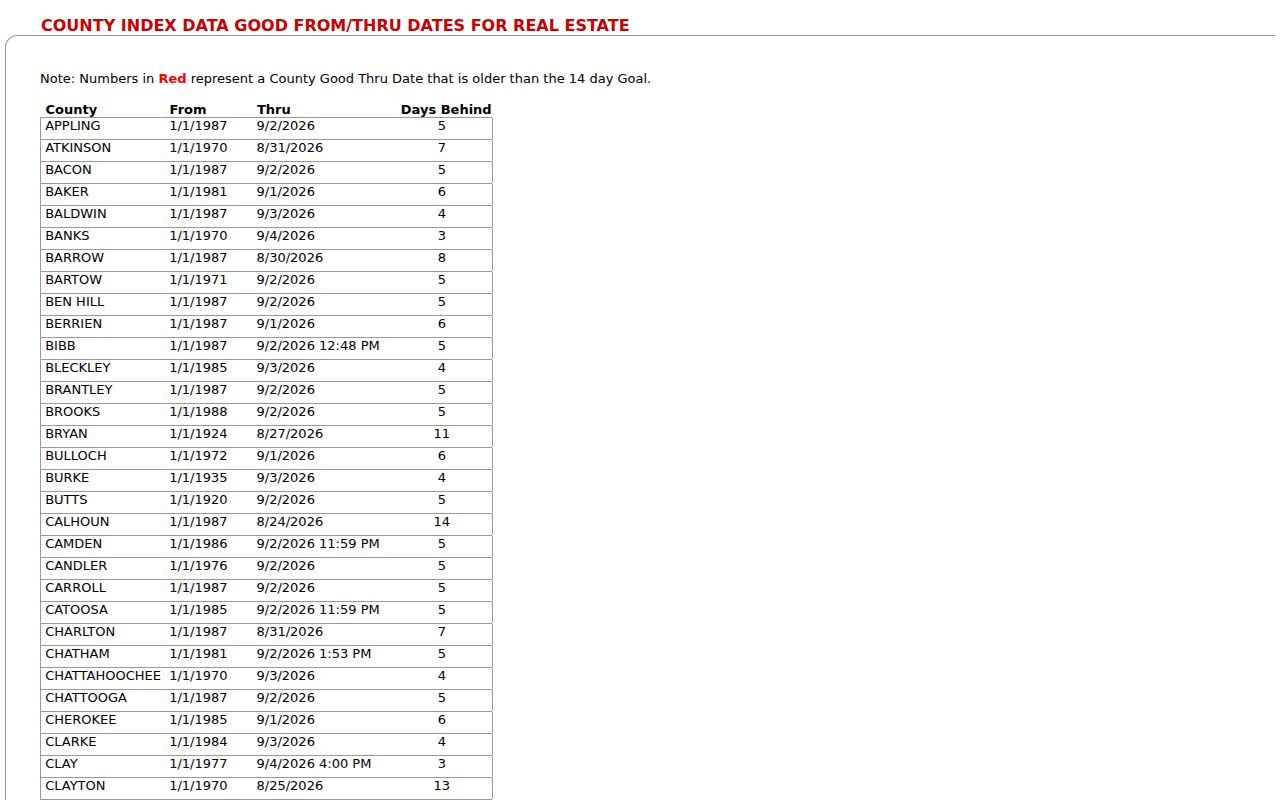
The table says to change channels at 1971. An absent web result does not mean no earlier owner ever held the land.
Coverage break. Online indexing reaches 1971. Continue earlier former-owner research in deed books, general indexes, microfilm, and archives.
Walk McIntosh Deeds Backward
A backward deed chain treats each transfer as a pointer. The newest instrument names the grantor. That grantor should then appear as grantee on an earlier acquisition for the same land. Match the parcel at every step. Common names, partial conveyances, subdivisions, and entity changes can all create false links.
- Start with the assessor owner and parcel key, then locate the newest deed naming that owner as grantee.
- Record the grantor, deed type, execution and recording dates, book/page, legal description, and prior-deed reference.
- Search that grantor as a grantee in an earlier date range. Test punctuation, initials, entity names, and spelling variants.
- Repeat until 1971, then follow the cited book/page into physical or filmed indexes for older former owners.
- Grantor
- The party transferring the interest stated in the instrument.
- Grantee
- The party receiving that stated interest.
- Chain of title
- The ordered line of conveyances affecting the same land.
- Reverse index
- An index organized to find the receiving party, useful for locating an acquisition.
- Quitclaim and warranty deed
- A quitclaim transfers the grantor's stated interest without the same covenants as a warranty deed; neither label alone proves a clean chain.
Search McIntosh Prior Owners
The GSCCCA name search offers Party Type, Instrument Type, County, a neighboring-county choice, Search Name, optional From and Through dates, and page-size and display options. Run both Grantor and Grantee. Start with warranty deed, quitclaim deed, deed from estate, sheriff's deed, tax sale deed, deed of gift, or court order. Those instrument filters narrow likely transfers. Then broaden the search to easements, releases, security deeds, liens, and estate documents. The official form itself displays all of these controls.
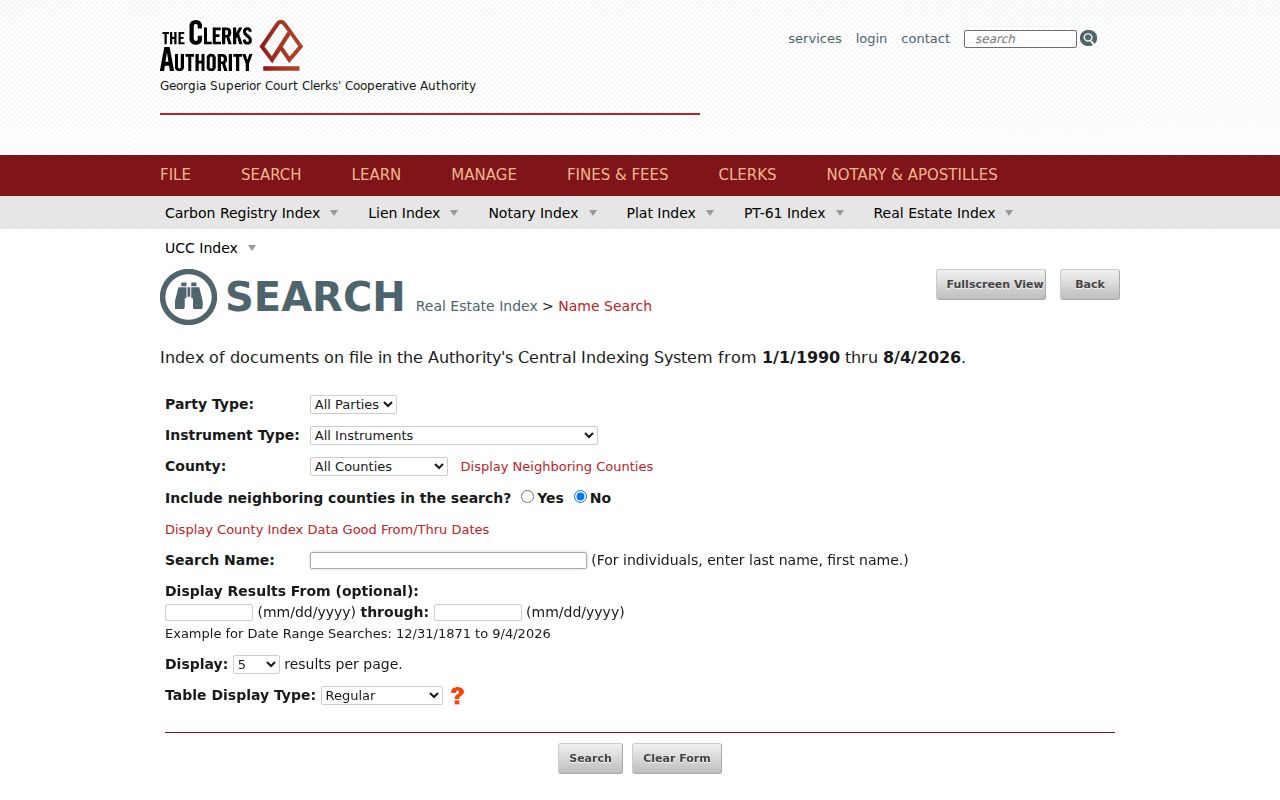
Names and dates come from the form. The deed image and clerk docket supply the legal description that keeps every step on the correct parcel.
McIntosh Courthouse Losses Matter
Courthouse losses explain why old chains break. Digital Library of Georgia sources place the first courthouse burning in 1864, with a courthouse completed in 1872, a 1931 fire, later additions, and 1986 damage. A Georgia Archives loss map gives different years: 1863, 1873, 1931, and 1981. Keep both versions. Forcing one timeline hides the disagreement. When a deed image or index disappears near a loss period, search tax digests, probate, newspaper legal notices, historic court files, later confirmation deeds, FamilySearch microfilm, and Georgia Archives county material. A surviving abstract may reconnect the chain. So may a judgment or tax entry. Even with the original conveyance gone, prior owners can remain recoverable.
Historic McIntosh Ownership Clues
Digital Library of Georgia newspapers from McIntosh include the Darien Gazette from 1818 to 1828, The Telegraph in 1835, short 1839-1840 runs, and the Darien Timber Gazette beginning in 1874. Estate notices, sheriff sales, tax sales, land advertisements, and business notices can name former owners. They also describe tracts predating the online deed index. The Lower Altamaha Historical Society holds local deeds, wills, obituaries, land-lottery material, official-record books, family files, and history clippings. Georgia Archives offers county microfilm. It also holds historic State Court Case Files from 1862 through 1930. All of this adds context and search terms. The recorded deed chain remains the conveyance evidence.
McIntosh Estates Break Clean Chains
Former owners can vanish from a sale-to-sale sequence. Land often passed through an estate or trust. Survivorship provisions, court orders, foreclosures, and tax sales break the pattern too. Search the deceased owner's exact assessor spelling and mailing address. Then review McIntosh Probate Court. Look there for a will, letters, inventory, petition for sale, or executor authority. Return to GSCCCA. Search it for deed from estate, estate documentation, affidavit, court order, release, and related grantor and grantee names. Keep the legal description in view. A fiduciary name changes; the land does not. An estate deed may cover only part of a tract. Probate evidence explains authority. The recorded instrument shows the conveyance.
McIntosh Land Names Change
Coastal land answers to many names. An island, marsh, river, plantation, subdivision, lot and block, acreage, or adjoining owner can stand in for today's road address. The assessor's neighborhood label may also differ from the legal subdivision on a plat. Carry both names through the deed index. Compare acreage, courses, prior book/page, and adjoining lands.
Variant searches matter for historic surnames. Local collections hold names like DuBignon, O'Brien, Gignilliat, McIntosh, and Wylly, with punctuation and spelling quirks. Try initials and punctuation-free forms, along with fiduciary roles and entity names. A modern parcel number helps. Older records may preserve a former map key after a split or combination.
Note: A street address is only a search aid; the legal description and prior-deed citation tie former owners together more strongly.
Reach Older McIntosh Records
The clerk's counter is the official route. Visit 310 North Way in Darien, Monday through Friday from 8:00 a.m. to 5:00 p.m. Bring names, parcel key, and book and page. Online GSCCCA access is convenient, though detailed images can involve credentials or charges. The clerk quotes certified-copy fees on request. FamilySearch image permissions vary. Georgia Archives in Morrow holds county and court material, and the historical society offers local research holdings. A Georgia Open Records Act request can help. It may seek an existing index, plat, or record, but it cannot require staff to build a chain of title. For the focused deed-copy process, see the McIntosh deed records page.
How Far McIntosh Owners Go
McIntosh former-owner research can reach back a long way. The online records stop at 1971. Deed books cataloged from 1863 continue the paper trail deeper. Earlier land history may survive in tax digests, land-lottery material, newspapers, probate, court files, and archive abstracts. None of that guarantees an unbroken chain of names. Records loss, shifting descriptions, partial transfers, and unrecorded interests can stop the proof.
Report the end point precisely. "No online result before 1971" is not "no former owner," and a chain rebuilt from secondary clues should carry that label until a recorded book, plat, court order, or later deed recital confirms it. For a legal title conclusion, use the clerk's official record and qualified title help.
Lawful use. Trace McIntosh prior owners for property history, estate work, or due diligence, never to track or harass a living person.