
Fields in McIntosh Property Tax Records
Valuation and collection sit with two different McIntosh County offices. The assessor keeps the parcel roll and the values. Tax Commissioner Wanda Nelson issues the bills and takes the payments. Always read the year and the source before comparing any two numbers.
| Field | What It Shows | Where |
|---|---|---|
| Fair-market value | Assessor's full-value estimate | Assessment roll |
| Assessed value | Standard 40% tax base, subject to exceptions | Assessment roll |
| Exemptions | Approved value reductions or special treatment | Assessor record |
| Tax bill and status | Charge, payment, or delinquent balance | Tax Commissioner |
| Tax year | Period to which each value and charge applies | Roll and bill |
A tax bill is not a sale price. Georgia generally assesses property at 40% of fair-market value, though exemptions and special programs can change the taxable figure. A recorded sale price is a separate fact about a separate transaction.
McIntosh Tax Offices Have Split Roles
The Board of Assessors appraises land. It maintains the digest, processes returns and exemptions, and handles value appeals. The office sits at 601 North Way in Darien. It is reachable at 912-437-6663 on weekdays from 8:00 a.m. to 4:30 p.m. The Tax Commissioner manages bills, payments, balances, delinquency, and tax sales. That office is at 1200 North Way in Darien, 912-437-6627, with the same posted hours. One caution applies. The collector cannot change an appraisal, so valuation disputes go to the assessor.
McIntosh Property Tax Digest Trend
The 2025 county notice reported $867,642,706 in real and personal value, a net digest of $724,973,863, a net M&O millage of 11.5000, and a levy of $8,337,199. That marked a 4.48% net tax increase over 2024. For comparison, the 2024 net digest was $693,874,247 and the M&O levy was $7,979,554.
These totals describe the whole county. They do not mean every parcel moved. A single property tax record can shift for many reasons: new construction, corrected traits, exemption changes, a sale review, or special-use status.
McIntosh Tax Value Terms
Fair-market value is the assessor's full-value estimate for a parcel. Assessed value applies the state assessment level to that figure. A mill is one dollar of tax per thousand dollars of taxable value. A homestead exemption is approved relief for a qualifying owner of record. A tax lien is a legal claim for unpaid tax, not just a late notice.
A recorded sale price may be qualified or unqualified. It may not match current market value. Compare property type, date, acreage, buildings, and transaction conditions before treating any sale as evidence.
Look Up a McIntosh Tax Bill
The Tax Commissioner links to the GovernmentWindow tax portal for bill lookups. Match the tax year and parcel number first. Then read the charge, any payments, adjustments, and the balance, and confirm current labels and any payment fee with the office before paying.
- Open the portal and read the current search choices.
- Enter the address, owner, bill number, or parcel key the live form accepts.
- Match the land and select the correct year.
- Read the charge, payments, adjustments, and balance, then compare exemptions with the assessor roll.
- Assessment notice
- The assessor's value notice and appeal route.
- Tax bill
- The collector's charge for a parcel and year.
- Delinquent balance
- An unpaid amount after the applicable due date.
- Tax sale
- A separate statutory process, not the same as an unpaid bill.
McIntosh Exemption and Return Forms
The assessor's form library covers address changes, property returns, exemptions, conservation, appeals, nondisclosure, and sales questionnaires. Georgia's general return period runs January 1 through April 1 unless another rule applies. Special programs include PT-283A for conservation use, PT-230 for preferential agriculture, PT-48-5-7.7 for forest land, PT-283S for wetlands, PT-283R for transitional property, and PT-283E for environmentally sensitive land. Each carries its own standards. An approved program can change tax treatment without changing the recorded deed.
McIntosh Field Inspections Are Active
The assessor states that field inspections are underway under O.C.G.A. §48-5-264.1. Inspectors verify physical traits and update records so taxation stays fair. They carry identification and generally work from the exterior. They need no appointment and rarely enter a home.
A changed property tax record deserves a closer look. Compare it with the parcel facts and permit history. The county publishes no local closing-to-roll delay. So weigh the assessment year against the latest recorded deed.
McIntosh Delinquency Is Not a Sale
A delinquent bill proves an amount and a status at one moment in time. It does not prove a sale is scheduled. The Tax Commissioner's tax-sales page offers no full current list, sale calendar, minimum bid, or bidder terms, so check county Public Notices and the Darien News legal organ for a lead. Confirm the parcel, dates, sum, and outcome with the Tax Commissioner and the clerk. Notice, sale, redemption, and a recorded tax-sale deed are separate events.
The official Tax Sales page shows the Tax Commissioner's route to sale information.
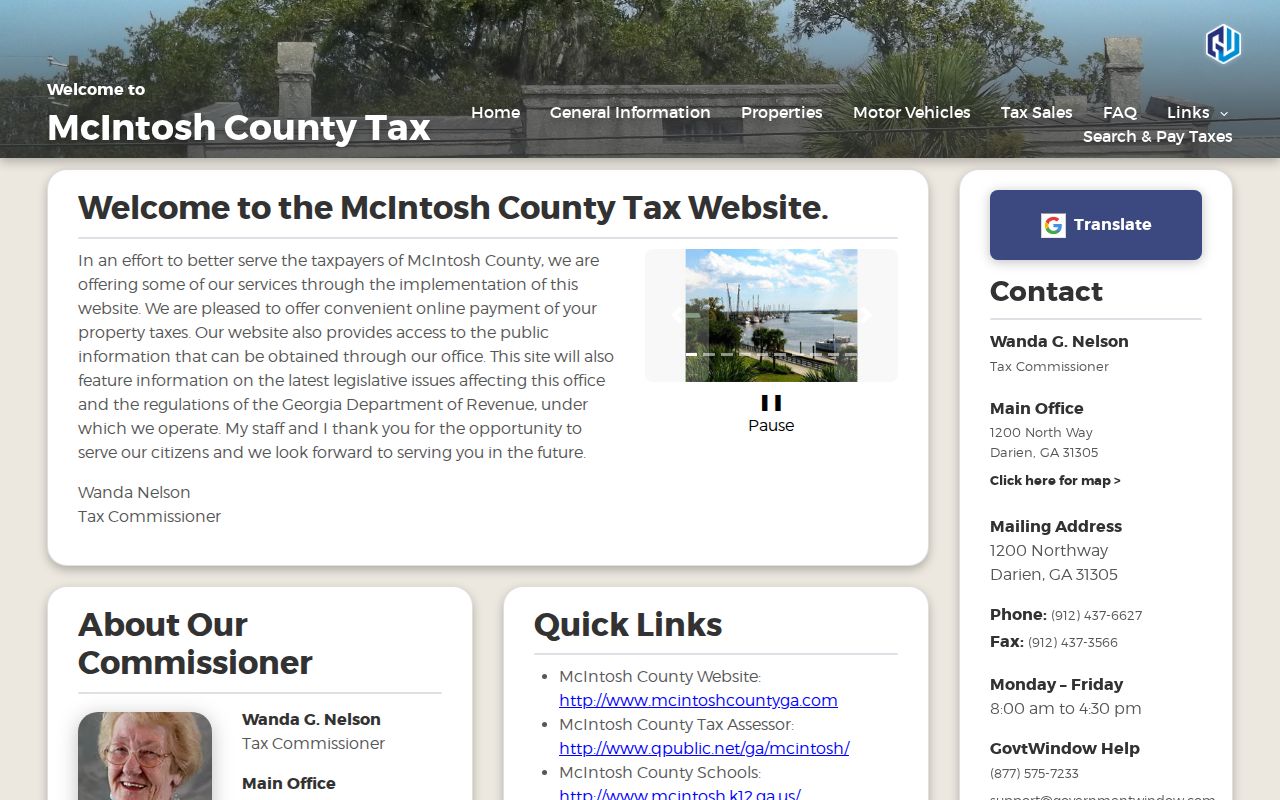
The page points you to the right office, but a complete live parcel list is not published there, so the Tax Commissioner remains the source for full tax-sale details.
Appeal a McIntosh Assessment
Georgia guidance generally allows 45 days from the date on an assessment notice to appeal. Use the local PT-311A route and honor the deadline printed on your actual notice. Evidence might include corrected building or land facts. Qualified sales also count. Photographs, surveys, permits, or proof of an exemption or special classification can help too. File with the Board of Assessors, not the Tax Commissioner. Keep proof of delivery. Keep copies of the notice, the form, your exhibits, and any responses. Point to the exact disputed field and the record that supports a correction.
Appeal window. File with the McIntosh County Board of Assessors by the date printed on the notice; Georgia guidance generally allows 45 days.
Anchor every McIntosh appeal to one disputed fact. Is it land size or shape? Compare the assessor entry with a plat or survey. For a building characteristic, gather photographs, permit records, inspection records, and the correct effective date. For a value dispute, use qualified sales that resemble the subject in property type, location, acreage, building area, age, and condition. Qualified sales carry the most weight. The McIntosh Sales Search helps. Its filters span one-month through seven-year presets, a custom date range, sale-price limits, qualified and unqualified status, property type, land and building ranges, acres, year built, street, and neighborhood. Every result still needs review before it becomes evidence. Neighborhood labels in McIntosh are unusually granular. Choices cover island, river, subdivision, downtown, rural, mobile-home, and conservation settings, including Barbour Island, Eagle Neck, Sapelo Gardens, Shellman Bluff, Darien Historical District, Eulonia Lake Estates, Tolomato, and Yellow Bluff River. A label groups sales, yet it may not match the legal subdivision on a plat. Verify the parcel, deed, land class, and qualified-sale flag. A related-party transfer, estate deed, tax deed, or sale with unusual conditions may not reflect an ordinary open-market deal.
An exemption dispute calls for different proof. Match the application, filing date, eligibility facts, and assessor decision to the tax year under appeal. Conservation, forest, wetland, preferential agricultural, transitional, and environmentally sensitive programs each carry distinct forms and rules. They can change the assessed or taxable relationship without changing the recorded owner or the fair-market estimate the same way. The program value does not always sit where you expect. Ask the assessor which value field reflects the program. A returned assessment notice can also expose a mailing-address problem in the tax roll. The situs address identifies the property. The mailing address tells the county where notices go. They often differ for an LLC, estate, trust, island tract, or owner living outside McIntosh County. Use the assessor's address-change process to fix the tax-roll contact. Never edit a situs to match a mailing label. Bring the parcel number and legal description so staff know which field needs attention.
Delinquency research in McIntosh property records should keep four distinct events separate. A bill may show an unpaid balance. A public notice may announce a possible sale. Statutory issues or redemption can follow the sale itself. A tax-sale deed, if one was recorded, documents the conveyance of title. Search the Tax Commissioner record, county Public Notices, the Darien News, and the GSCCCA instrument index in that order. An unpaid amount does not mean lost title. A notice does not prove the advertised sale occurred. When the portal omits an older bill, payment detail, notice attachment, or digest record, contact the Tax Commissioner or use the county's open-records route. State the parcel, tax year, owner or bill name, record type, and a narrow date range. McIntosh routes GORA requests through the County Attorney. An agency response or production notice generally begins within three business days. The first 15 minutes of staff search time are free. Standard copies run $0.10 per page. Estimates above $25 need approval, and requests above $500 may require prepayment.
Keep the notice and tax bill separate in the file. The notice supports the value and appeal timeline. The bill supports the amount charged and paid. Mark each printout with its source, since a later payment or adjustment can change the online balance. For a closing or estate matter, request an official statement when a current amount must be confirmed. Countywide digest figures offer context, not a parcel answer. McIntosh's 2025 notice listed $867,642,706 in real and personal value, $724,973,863 in net digest value, an 11.5000 mill rate, and an $8,337,199 maintenance and operations levy. Compare totals with the 2024 notice at county level only. They cannot explain why one home, marsh tract, timber parcel, or commercial site changed. One parcel can move for reasons the digest never shows. That question requires the parcel's assessment notice, characteristics, exemptions, qualified comparable sales, and any field-inspection update for the same tax year.